UK Health Security Agency (UKHSA) has recently confirmed a localised outbreak of Meningitis B (MenB) in the Canterbury area of Kent.
The most important message is that there is no increased risk to people living in York, and no changes have been made to the national vaccination programme.
What Has Happened in Kent?
UKHSA has reported a cluster of invasive meningococcal disease (MenB) cases linked to a specific venue in Canterbury. Public health teams in Kent are working directly with people who may have been exposed, offering antibiotics and vaccination where appropriate.
This is a local outbreak, and UKHSA has confirmed that the wider public is not at increased risk.
Does This Affect Vaccination Eligibility?
No.
The NHS has not changed who is eligible for the MenB vaccine.
The MenB vaccine (Bexsero) continues to be offered routinely to:
- Babies at 8 weeks, 16 weeks, and 1 year
- People with certain high‑risk medical conditions
- Close contacts of confirmed cases, if advised by UKHSA
There is no national programme to vaccinate older children, teenagers, or adults outside these groups.
NHS guidance on the MenB vaccine remains unchanged.
There are different types of bacterial meningitis caused by different strains of bacteria.
- Meningitis B, or MenB, is now the most common in the UK – accounting for over 80% of invasive infections – since vaccination made other forms much rarer.
- Group B bacteria are not a single strain, but encompass many different forms of meningococcal B bacteria.
- There is a vaccine given to babies that protects against the most common, but not all, group B bacteria.
- Since it was introduced in 2015, MenB infections have been reduced by around 75% in those immunised.
- However, anyone over the age of 11 has not been protected unless their parents paid for the vaccine privately.
- The risk from MenB is highest in very young children and older teenagers and young adults – often linked to going to university.
- However, a vaccination campaign for teenagers was not considered to be cost-effective. This is because the vaccine is expensive and does not stop you spreading the infection, but rather stops you getting seriously ill.
Frequently Asked Questions
- Can I get the MenB vaccine now if I wasn’t eligible before?
- At present, eligibility has not changed. Only those in the routine childhood schedule or identified as close contacts by UKHSA are being offered the vaccine.
- Can I pay privately for the MenB vaccine?
- Some private providers do offer MenB vaccination.
- Is my child protected?
- Yes—since 2015 children have received the MenB vaccine as part of the routine NHS childhood immunisation schedule, which provides strong protection against the strain involved in the Kent outbreak.
- Teenagers also receive the MenACWY vaccine, which protects against four other meningococcal strains.
- Why is the MenB vaccine not given to teenagers in the UK?
- It’s down to how effective that vaccine is seen to be in that age group.
- Research suggests the MenB vaccine doesn’t influence transmission of the infection from one person to another, it doesn’t target against all the different B bacteria strains and doesn’t protect for particularly long either.
- For all those reasons, and despite campaigns by charities to have it introduced, UK vaccine experts have concluded that the MenB vaccine isn’t cost effective on the NHS for adolescents.
- Babies are offered the MenB vaccine and given three doses in the first year of life. That’s because young babies are more likely to get invasive infections more often than other age groups, and their bodies are less likely to be able to fight them off, experts say.
- Teenagers are currently offered the MenACWY vaccine, which has reduced the number of young people getting ill from meningitis and spreading those bugs. But uptake of that vaccine is still not where it was before the pandemic – about 73% of 13-year-olds were vaccinated last year in England. Among 14 year olds, uptake was 75%.
- What symptoms should I look out for?
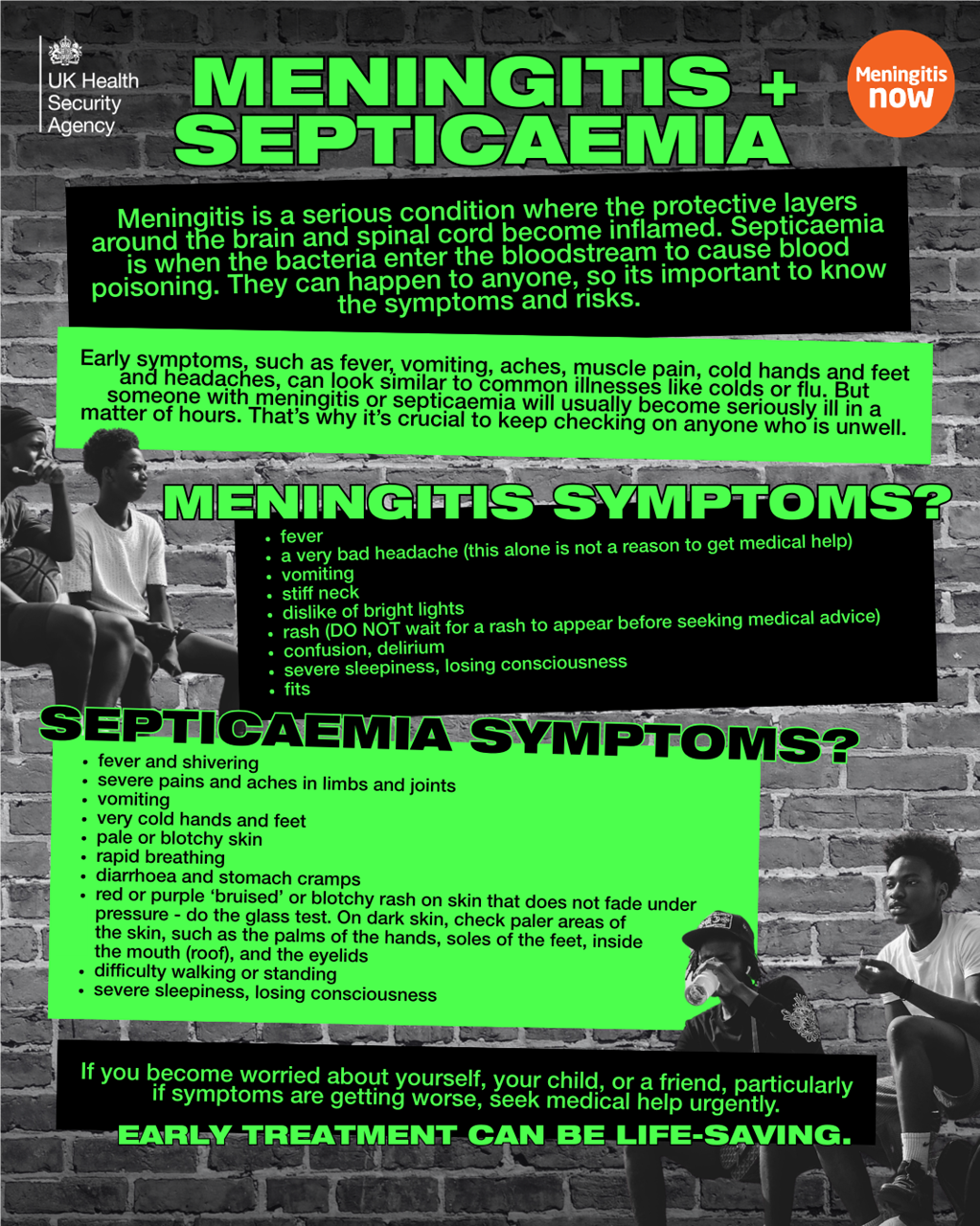
- Meningitis can develop quickly. UKHSA and the NHS advise seeking urgent medical help if you notice:
- Fever, cold hands and feet
- Headache, vomiting
- Rapid breathing
- Drowsiness or confusion
- A rash that does not fade when pressed with a glass
- If you are ever worried about symptoms, call 111 or seek urgent medical care.